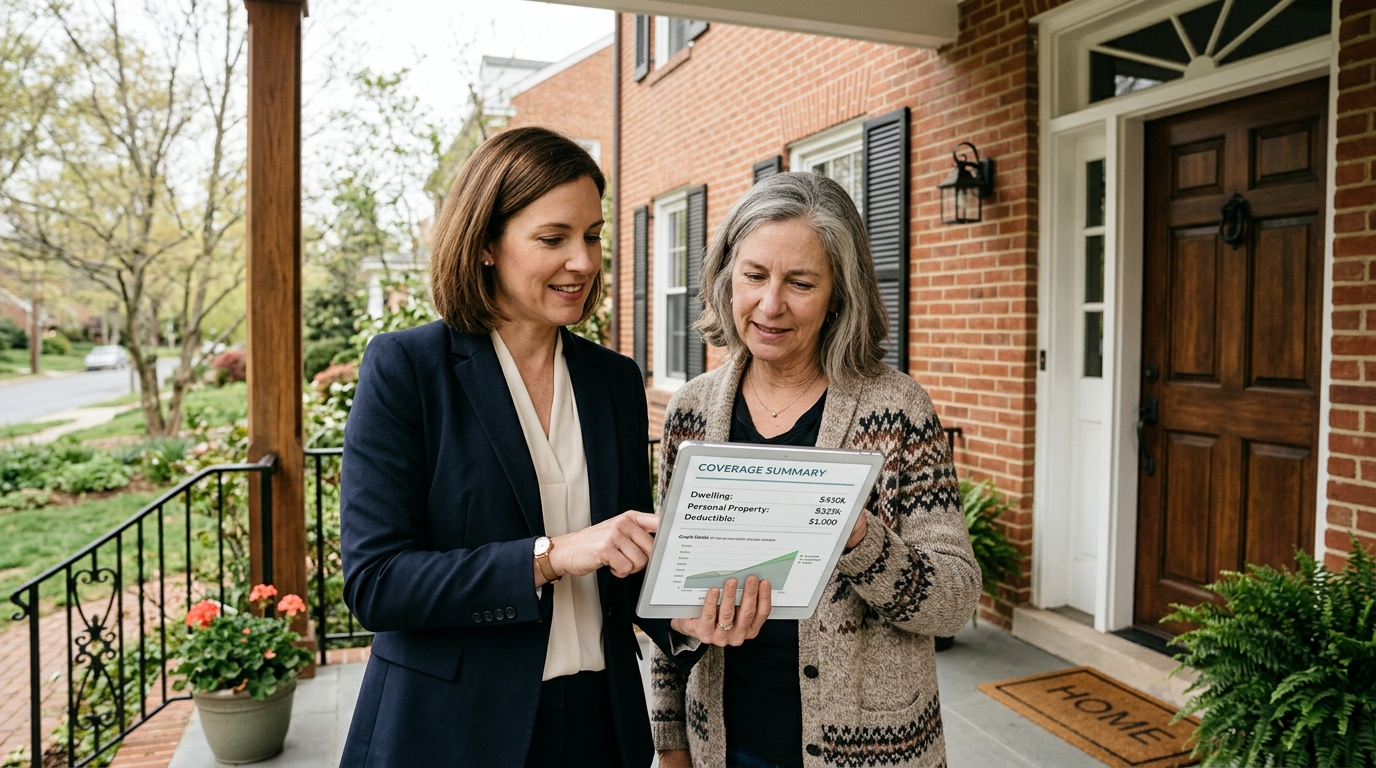
What drives Baltimore MD homeowners insurance rates
If you've recently gotten a renewal notice and wondered why your Baltimore MD homeowners insurance rates look nothing like what your neighbor pays, you're not imagining things. Rates in the Baltimore metro area vary widely from block to block, home to home, and carrier to carrier. Understanding what actually moves the needle can help you make smarter coverage decisions and avoid paying more than you should.
Location factors that carriers weigh heavily
Maryland is a geographically varied state for insurers. There is coastal exposure from the Chesapeake Bay, aging urban housing stock in Baltimore City, suburban sprawl through Howard and Baltimore Counties, and flood-prone corridors along rivers like the Patapsco. All of that gets baked into your rate.
ZIP code and neighborhood risk
Carriers use ZIP code-level data to assign base rates. A home in Roland Park or Guilford carries different baseline pricing than one in Middle River or Dundalk, partly because of differences in crime statistics, fire department response times, proximity to hydrants, and historical claims frequency in that area. This is not a judgment call by your agent. It is actuarial data the carrier files with the Maryland Insurance Administration (MIA) when they submit their rate plans.
Flood and storm exposure
Standard homeowners policies in Maryland do not cover flood damage. That said, carriers still factor proximity to flood zones into overall risk scoring, because water-adjacent homes are more likely to have water intrusion claims even outside of declared flood events. Homes near the Inner Harbor, along Gwynns Falls, or in parts of Catonsville near the Patapsco River see this reflected in their pricing. If you live in a designated flood zone, you'll need a separate flood insurance policy on top of your homeowners coverage.
Severe weather patterns
The Baltimore region faces a full range of weather risks: nor'easters, summer thunderstorms with hail, tropical storm remnants pushing up from the Chesapeake, and ice storms in winter. Carriers track years of weather-related claims at the county and ZIP level and price accordingly. Howard and Baltimore County homeowners have seen rate pressure increase over the last several years, partly because of hail and wind events that generated a significant volume of roof claims.
Your home itself: what carriers look at
Even within the same ZIP code, two houses can have very different premiums based on the physical characteristics of the property.
Age and condition of the roof
This is one of the biggest single variables in your rate right now. Many carriers in Maryland will not write a policy on a roof older than 20 to 25 years, or they will write it with a cosmetic damage exclusion or a much higher wind/hail deductible. A new architectural shingle roof can meaningfully lower your premium compared to an aging three-tab roof. We wrote a full breakdown in our post on how your roof affects home insurance costs if you want the full picture.
Construction type and age of the home
Baltimore has a lot of older housing stock. Rowhouses, stone Victorians, and brick colonials from the early and mid-20th century are common throughout the city and first-ring suburbs. Older homes often have knob-and-tube or aluminum wiring, galvanized steel pipes, and original cast iron plumbing. Carriers charge more to insure these homes because the cost to repair or replace systems that suffer damage is higher, and the probability of certain loss types (electrical fires, plumbing failures) is elevated.
Replacement cost vs. market value
Your homeowners policy insures the replacement cost of the structure, not its market value. In some Baltimore neighborhoods, the market value of a rowhouse might be $200,000 but it could cost $350,000 or more to rebuild it from the ground up with current labor and material costs. Your dwelling coverage limit needs to reflect the rebuild cost, not what Zillow says. Underinsuring to save premium is a trap that leaves you badly exposed after a major loss.
Home security and protective devices
Central station monitored alarm systems, deadbolt locks, and smart smoke detectors can qualify you for discounts with most carriers, typically in the range of 5 to 15% depending on the company. These credits are easy to capture and tend to stick year over year.
Personal factors that affect your premium
Beyond the property itself, carriers look at you as a policyholder.
Claims history
Maryland carriers can access the CLUE (Comprehensive Loss Underwriting Exchange) report, which shows claims filed on a property and by a policyholder for the past seven years. Multiple claims in a short window raise red flags. Even claims paid out at relatively small amounts can affect your renewability and your rate. It's worth being thoughtful about whether to file a claim for a small loss versus paying out of pocket, especially if you've had recent activity.
Credit-based insurance score
Maryland permits carriers to use credit-based insurance scores in personal lines rating, within certain guardrails set by the MIA. This is separate from your credit score but derived from similar underlying data. Homeowners with stronger credit profiles generally pay less. An insurer can legally use this factor in Maryland, but they cannot use it as the sole reason to cancel or non-renew a policy.
Your deductible choices
Raising your all-peril deductible from $500 to $1,000 or $2,500 can reduce your annual premium noticeably, often by 10 to 20%. Some policies in Maryland now carry a separate wind/hail deductible expressed as a percentage of the dwelling coverage (typically 1 to 2%), rather than a flat dollar amount. On a $400,000 dwelling that is a $4,000 to $8,000 out-of-pocket exposure per storm event. Make sure you understand what your deductible structure actually says before you assume you know what you owe after a claim.
Why the carrier you choose matters as much as the property factors
Rate filings differ dramatically between carriers, even for the same house. One company may be aggressive on older homes with updated electrical but conservative on homes with wood-burning fireplaces. Another may offer very competitive rates in Baltimore County but price Baltimore City out of their appetite entirely. This is why working with an independent insurance agent gives you a real advantage over going direct to a single carrier. An independent agent can run your information across multiple admitted carriers and compare what each one is actually quoting for your specific home and risk profile.
If you want a broader grounding in how Maryland homeowners coverage works before shopping rates, our Maryland homeowners insurance guide walks through the coverage components, state-specific considerations, and what to look for in a policy.
How to lower your Baltimore homeowners insurance rate
There are realistic levers you can pull without gutting your coverage.
- Bundle your auto and home. Most carriers offer a meaningful multi-policy discount, often 10 to 20% , when you place your homeowners and auto policies with the same company.
- Update aging systems. Replacing knob-and-tube wiring, upgrading a panel, or replacing galvanized pipes with copper or PEX can open up more carrier options and lower your rate at the same time.
- Shop at renewal. Maryland carriers can adjust rates at renewal within their filed rate plans. If your carrier took a rate increase this cycle, it is worth getting a fresh market comparison rather than accepting the new number.
- Ask about loyalty and claims-free discounts. Some carriers reward long-term policyholders who have not filed claims. These discounts are not always applied automatically, so ask your agent to confirm they are on your policy.
- Review your liability and umbrella limits. If you are carrying the bare minimum liability on your homeowners policy, it may be worth adding a personal umbrella policy for broader protection rather than simply increasing your homeowners premium for a higher limit. Umbrella coverage is typically more cost-efficient once you cross certain thresholds.
What you should actually check on your current policy
A lot of homeowners in the Baltimore area are underinsured and don't know it. When is the last time your dwelling coverage limit was updated to reflect current construction costs? Material and labor costs have shifted significantly over the last several years. If your home was insured to value in 2019 and you haven't revisited the limit since, there's a real possibility you are carrying a gap.
Also check your personal property coverage limit and whether it is actual cash value or replacement cost. Actual cash value pays you the depreciated worth of your belongings after a covered loss. Replacement cost coverage pays what it actually costs to replace them with new items. The premium difference is usually modest; the claims difference can be substantial.
Finally, look at your additional living expenses (ALE) coverage. If a covered loss makes your home temporarily uninhabitable, ALE pays for hotel, meals, and other costs while repairs happen. With Baltimore and Howard County contractors often booked out weeks or months, a repair that used to take two months can now take four or six. Make sure your ALE limit reflects that reality.
Ready to get a clearer picture of your rate
J.E. Schenk & Associates is an independent insurance agency serving homeowners throughout the Baltimore metro area, including Ellicott City, Catonsville, Columbia, and surrounding communities. Because we work with multiple carriers rather than one, we can compare options side by side and find coverage that fits your home, your risk tolerance, and your budget. We don't push you toward a single product line. We help you understand what you're buying and why it's priced the way it is.
If you'd like a review of your current homeowners policy or a fresh rate comparison, reach out to our team directly. You can call us at (410) 465-7474 or get in touch through our contact page and we'll take it from there.